


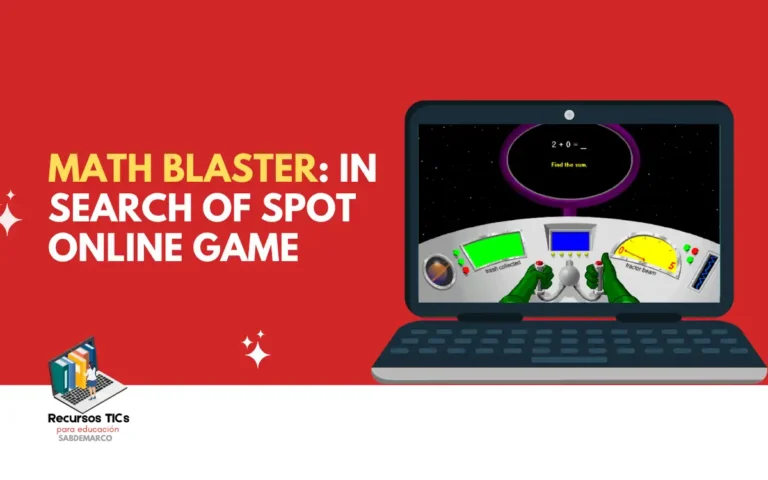
Math Blaster is an educational space-adventure game in which kids solve arithmetic problems to power a hero called Blasternaut through arcade challenges. It matters because it turns repetitive math-fact drills into missions children actually want to finish, which builds speed and confidence at the same time. The best-loved edition, the math blaster 90s release In Search of Spot, still runs today as a math blaster online game, right in your browser.
What is Math Blaster?
Math Blaster online, often searched as mathblaster, is a series of edutainment games created by former teacher Jan Davidson and first published by Davidson & Associates in 1983 for the Apple II and Atari 8-bit computers.
The original was a plain collection of space-themed drills, but the 1993 remake, Math Blaster Episode I: In Search of Spot, added animated cutscenes, voice acting and a real storyline. In it, the villainous Trash Alien kidnaps Spot, Blasternaut’s robot sidekick, and the Galactic Commander sends the player across the galaxy to rescue him. PC Magazine ranked it among the top 100 CD-ROM titles of 1994.
As a math blaster pc game, In Search of Spot works like a flexible practice engine rather than a fixed lesson. Parents or teachers pick the subject (addition, subtraction, multiplication, division, fractions, decimals and percents, estimation, number patterns or a mixed review) and choose a difficulty level, so the same disc serves a first grader and a sixth grader.
By June 1997 the franchise had sold five million copies, and later entries kept the formula alive. Math Blaster: Master the Basics, for example, arrived in 2005 with 3D graphics and comic-book cutscenes, and won a National Parenting Center Seal of Approval in 2006.
| Version | Year | Platforms | Ages | What stands out |
|---|---|---|---|---|
| Math Blaster! | 1983 | Apple II, Atari 8-bit | Elementary | The original set of space-themed drills |
| Episode I: In Search of Spot | 1993–1994 | DOS, Windows, Mac, SNES, Genesis | 6–12 | First entry with a story, cutscenes and voices |
| Mega Math Blaster | 1996 | Windows, Mac | 6–9 | Remake of In Search of Spot |
| Math Blaster: Master the Basics | 2005 (Mac in 2007) | Windows, Mac | 6–12 | 3D graphics and a robot-ruled future |
| Math Blaster online | 2011–2023 | Browser, mobile | 6–12 | JumpStart’s online world, closed in July 2023 |
What age is Math Blaster for?
Math Blaster: In Search of Spot is designed for children ages 6 to 12, roughly first through sixth grade. In a school or homeschool setting it works best as reinforcement: once a child has met a concept in class, the game turns it into fast, automatic recall through dozens of short problems. Because the topic and difficulty are set before each mission, a teacher can match the challenge to each student’s level instead of giving the whole group the same worksheet.
Younger players, around 6 or 7, handle the addition and subtraction rounds well, although they may need an adult nearby for the arcade parts. Aiming the tractor beam, steering the jet pack and dodging debris all demand hand-eye coordination with the mouse, and reviewers at the time flagged those sections as the hardest for small kids.
Children from 9 to 12, on the other hand, get the most out of fractions, decimals, percents and estimation, where speed starts to matter and the review mode mixes every topic together.
Read More: Aprender inglés gratis ¡es posible!
How do you play Math Blaster?
The easiest way to play Math Blaster today is right on this page, since the window above runs the original Windows CD inside a browser emulator. That means there’s no math blaster download, no old discs and no compatibility headaches: the 1990s software loads in a few seconds and works with your mouse and keyboard. To get started:
- Open this page on a computer with an up-to-date browser such as Chrome, Edge or Firefox.
- Click inside the game window and wait for it to finish loading.
- Choose a math topic and difficulty level that fit the child’s grade.
- Start the mission and listen to the Galactic Commander’s briefing.
Once the mission begins, the math blaster play loop is simple: every correct answer gives Blasternaut something he needs, such as tractor-beam power, fuel or a safe path through a cave. Wrong answers don’t end the game; they just slow progress, so kids get a second chance to think instead of feeling punished. The four activities link together into one rescue story, and finishing all of them frees Spot from the Trash Alien.
From a teaching point of view, it helps that each activity can also be played on its own, for practice or for a high score. If a child struggles with multiplication, a parent can set that topic and repeat only the Trash Zapper until the facts feel automatic. Short sessions of 15 to 20 minutes, followed by a quick chat about which problems felt hard, usually work better than one long marathon in front of the screen.
What games are inside Math Blaster?
In Search of Spot includes four activities, and each one trains a different side of math:
- Trash Zapper: Blasternaut solves equations to charge his tractor beam, then aims it at floating space trash marked with numbers. It drills basic math facts, and once 15 pieces are collected the mission moves on.
- Number Recycler: available only in the PC version, it asks the player to slide columns of numbers and operators until they form correct equations. Every valid equation melts the collected trash into rocket fuel, so it rewards logical thinking over pure speed.
- Cave Runner: using a jet pack, the player flies through an underground cave and passes number-based gates that hold the right answers. It combines quick calculation with steering, which keeps attention high.
- Math Blaster: the final showdown aboard the Trash Alien’s ship, where the player chooses the correct answer among several portholes while avoiding trash. It works as a timed quiz that reviews everything practiced earlier and ends with Spot’s rescue.
What skills does a child develop with Math Blaster?
Playing Math Blaster regularly strengthens both math ability and broader learning habits. These are the main skills a child builds:
- Math-fact fluency: repeated, timed practice makes addition, subtraction, multiplication and division answers automatic.
- Number sense: estimation rounds and number patterns help kids judge whether a result makes sense.
- Equation building: the Number Recycler shows how numbers and operators fit together, an early step toward algebra.
- Work with fractions, decimals and percents: higher levels connect these three ways of writing the same value.
- Hand-eye coordination: aiming, steering and dodging require precise mouse control.
- Focus and persistence: a mission only ends when every activity is complete, which teaches kids to keep going after a mistake.
- Confidence with math: small wins inside a story reduce math anxiety and make practice feel like play.
Did you grow up playing Math Blaster on the family PC, or is your child discovering it for the first time? Tell us in the comments which mission gave you the most trouble.