





It is well known that women’s contributions to progress and the economy have not always been recognized, and Women Scientists are no exception. So much so that since 2015, February 11 has been celebrated as the International Day of Women and Girls in Science, dedicated to recognizing the crucial role women play in the scientific and technological community and promoting gender equality in these fields. Today, many initiatives, including the women science grant programs, aim to support and empower future generations of researchers. Below are 15 figures whose stories and discoveries will inspire your students.
Women Scientists of Antiquity
The list of Women Scientists could not begin with anyone other than Hypatia of Alexandria. However, she was not the only one in the ancient world.
1. Merit Ptah (2700 BCE). Egyptian physician, considered the first woman in medicine mentioned by name in historical records.
2. Hypatia of Alexandria (370–415 CE). Egyptian mathematician, astronomer, and philosopher, and one of the first women to make significant contributions to science and philosophy.
3. Aglaonike (2nd century BCE). Greek astronomer known for predicting lunar eclipses.
4. Metrodora (200–400 CE). Greek physician and author of one of the earliest known medical texts written by a woman.
You may also be interested in: Ideas to commemorate Women’s Day in the classroom
These Women Scientists made significant contributions in their respective eras and left a lasting legacy in the history of science.
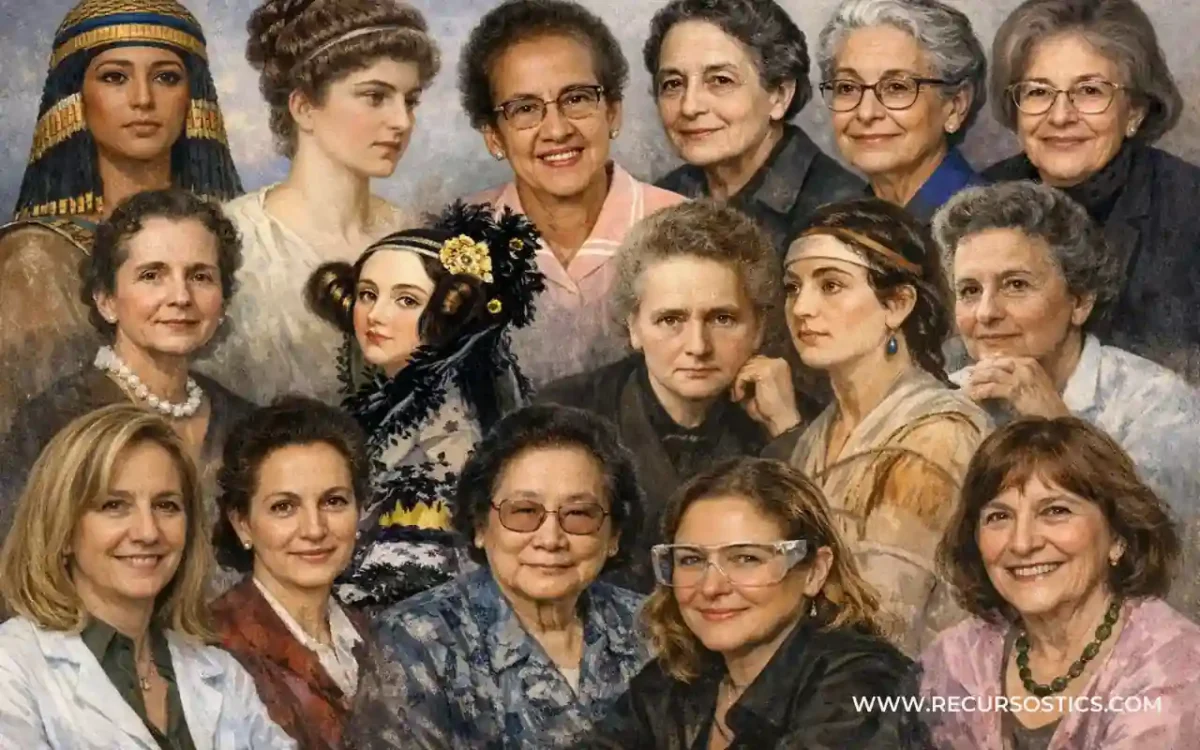
Pioneer Women Scientists of Modern Science
Let’s meet the pioneers who dedicated themselves to science when this activity seemed reserved only for men. They paved the way for future generations of Women Scientists, including many women computer scientists and innovators.
5. Ada Lovelace (1815–1852). Considered the first computer programmer for her work on Charles Babbage’s Analytical Engine. She wrote the first algorithm intended to be processed by a machine, making her one of the earliest women computer scientists. She recognized that computers could go beyond numerical calculations and be used for general tasks. She was the daughter of the famous poet Lord Byron.
6. Marie Curie (1867–1934). Pioneer in the field of radioactivity and the first person to win two Nobel Prizes in different disciplines (Physics and Chemistry). Her maiden name was Maria Salomea Skłodowska, but she became widely known as Marie Curie.
7. Lise Meitner (1878–1968). Recognized for her pioneering work in nuclear fission. She was born into a Jewish family and studied at a time when Austrian women were excluded from universities. Despite being nominated for the Nobel Prize in Chemistry in 1939 with Otto Hahn, he alone received it in 1944.
These pioneers helped establish the foundations of women science engineering and opened doors for women in scientific research.
Women Scientists of the 20th Century
8. Rosalind Franklin (1920–1958). Made crucial contributions to understanding DNA structure through X-ray crystallography. Her famous “Photo 51” helped scientists discover the DNA double helix.
9. Katherine Johnson (1918–2020). Mathematician who calculated NASA spacecraft trajectories, including the first crewed Moon mission. Her work represents a milestone among women computer scientists and space researchers.
10. Rachel Carson (1907–1964). Marine biologist and author of the influential book Silent Spring, which helped launch the modern environmental movement.
You may also be interested in: 11 Computer Activities for Children
11. Vera Rubin (1928–2016). Pioneer in measuring galaxy rotation. Her research provided strong evidence for the existence of dark matter, making her one of the most influential astronomers of her time.
These achievements continue to inspire famous women scientists today, many of whom are advancing research in artificial intelligence, medicine, and environmental science.
Pioneers for the 21st Century
An example of those shaping the future of Women Scientists in the new century:
12. Tu Youyou (1930–). Discovered artemisinin, a compound used to treat malaria. Her discovery has saved millions of lives worldwide. She received the Nobel Prize in Physiology or Medicine in 2015 and remains one of the most famous women scientists today.
Argentine Women Scientists
13. Cecilia Bouzat. Argentine neuroscientist recognized for her research on neuron communication. She received the L’Oréal-UNESCO Award for Women in Science, supported by global women science grant initiatives.
14. Gabriela Gerosa. Industrial chemist who was part of a team awarded the Nobel Prize in Chemistry in 2021 for research in asymmetric organocatalysis.
15. Alicia Dickenstein. Distinguished Argentine mathematician and professor at the University of Buenos Aires, awarded the L’Oréal-UNESCO Prize for Women in Science and the Konex Platinum Award.
These scientists demonstrate the importance of representation and opportunity through programs such as the women science grant, which supports innovation and education.
Databases to Find Information About Women Scientists
Here, we have mentioned only 15 of the hundreds or thousands of Women Scientists who have contributed to scientific progress. To find more information, we recommend the following resources:
UNESCO – L’Oréal: Since its creation, the L’Oréal-UNESCO “For Women in Science” program has awarded more than 4,100 scientists and supported thousands through women science grant initiatives in over 110 countries.
Women with Science: A blog from the University of the Basque Country featuring biographies, interviews, events, and stories about Women Scientists.
Notables of Science: A platform highlighting major figures in Argentine science, including many famous women scientists today.
Read also: Ideas to commemorate woman day in the classroom
We have reached the end of this guide on “15 Women Scientists to study in the classroom.” We hope it has been useful. Remember that at Recursos TICs you will find resources and tools for your computer science classes. Do not hesitate to contact us with any questions or suggestions. Follow us on social media to stay updated with our news.
What did you think about this content? Leave us your comments!